Central Hong Kong Hotels From Glass Towers to Historic Back Alleys
Central Hong Kong hotels range from glass-tower luxury to escalator-accessed back-alley stays, with Lan Kwai Fong noise as the hidden cost.
Central Hong Kong Hotels: Two Cities in One Block
A standard double room in Central costs HKD 3,200 a night at the median rate, 2024 data from property analytics firms puts it there. That is a 35 to 50 percent premium over Tsim Sha Tsui for the same category. What you get in return is not a view. What you get is the ability to walk to the Peak Tram, the Star Ferry, Lan Kwai Fong, SoHo, Tai Kwun and three Michelin-starred restaurants without touching the MTR. What you also get, and what no brochure mentions, is a bedroom suspended above a bar grid that roars until four in the morning on weekends. The tradeoff is the whole point of staying here. You just need to know which side of the lane to sleep on.
Glass Tower Corridor Versus The SoHo Warren
Central splits cleanly into two territories. The first is the glass tower corridor that runs north of Queen's Road Central, where the Four Seasons, the Mandarin Oriental, The Murray and the Conrad Hong Kong stack their guests in 28 to 32 square metres of air conditioned luxury. These properties sit on or above the walkway network that connects the Airport Express Hong Kong Station at 1 Man Yiu Street to the MTR Central station, which handled roughly 350,000 entries and exits daily in 2023. You can travel from hotel lobby to Airport Express platform in under ten minutes and reach the airport in 24 minutes flat. The premium buys convenience in the rain, proximity to the Star Ferry pier and silence in the bedroom. The downside is that you are paying for a corridor, not a neighbourhood. The glass tower zone empties after 8pm. There is no street life.
The second territory is the warren behind Hollywood Road, accessible almost exclusively via the Mid Levels Escalator. That 800 metre system runs downhill from 06:00 to 10:00, then uphill from 10:20 until midnight. Its lower terminus sits on Queen's Road Central, 100 metres west of the Central Mid Levels walkway entrance. Its upper terminus reaches Conduit Road, the southern boundary of the area. This is the SoHo dining zone, bounded by Caine Road to the south, Hollywood Road to the north, Aberdeen Street to the east and Shelley Street to the west, with roughly 200 restaurants crammed inside. The hotels here are smaller. The Pottinger on Queen's Road Central, Ovolo Central on Arbuthnot Road, The Hari on Jervois Street. Rooms are tighter. Noise is louder. And the value is dramatically better.


Where the Noise Hits and Where it Drops
Lan Kwai Fong does not generate a gentle hum. Its core is an L shaped lane that spills noise east to D'Aguilar Street, west to the lower section of Wyndham Street and north to Wellington Street between those two. Peak noise hours run Friday and Saturday from 23:00 to 04:00. On those nights the road closes to traffic from 20:00 to 05:00. Any hotel room with a window facing that quadrant, and that includes every room in the Landmark Mandarin Oriental on the upper floors that overlook Wyndham Street, will hear bass until the cleaners arrive.
The Two Quiet Pockets Worth Booking
The solution is not to flee to a different neighbourhood. It is to pick a specific block within it. The quietest sleeps in Central sit on two pockets. The first is the stretch of Hollywood Road west of Aberdeen Street, where the residential building stock from the 1970s thickens the walls and the restaurants thin out. The second is the upper reaches of the moving walkway itself, above Staunton Street, where the bars give way to antique shops and the crowd dissipates. The Pottinger occupies a sweet spot here, on Queen's Road Central but set back from the Lan Kwai Fong grid by a full block and a half. Ovolo Central sits on Arbuthnot Road, which runs parallel to the escalator and catches less foot traffic after midnight. Both trade a short walk down the ride for a room that does not vibrate.
The Harbour Buffer And Its Tradeoff
There is a third option, and it is the most expensive for a reason. The Four Seasons Hong Kong sits on Man Cheung Street, west of Jubilee Street, the western boundary of the district. It faces the harbour, not the neon. The noise reach of Lan Kwai Fong stops well before its lobby. You pay for that buffer. The 2024 median rate for a standard double in that property sits far above the district median of HKD 3,200. The tradeoff is that you are no longer walking to everything. You are walking to the ferry and the airport express, but dinner requires a taxi or a 15 minute walk through the tunnel to IFC Mall. Decide which failure you can live with.
The Physical Cost of Walkability
Visitors who book Central for the walkability factor underestimate what that walkability actually demands. The district is built on a steep incline. The escalator helps, but it only runs one direction for 16 hours a day. Between 06:00 and 10:00 it moves downhill only. If you are staying in the SoHo zone and want to get to the Star Ferry at 9am, you walk down or you take the stairs. There are a lot of stairs. The Peak Tram terminus sits on Garden Road, the eastern boundary of the district. From the escalator midpoint, that is a 15 minute walk that involves two flights of covered steps and a signal crossing. From the Four Seasons, it is a flat 10 minute walk through the walkway network. Know which route you are committing to before you book.
Heat, Humidity And The Taxi Problem
The humidity compounds the effort. Between June and August the city sits at 90 percent humidity with temperatures above 32 degrees Celsius. Walking from the Mandarin Oriental to the Man Mo Temple will soak a shirt through. The hotel concierge can call a taxi, but short taxi rides within Central are frequently refused by drivers who do not want to cross the harbour and prefer longer fares. The HK Taxi app, which you should download immediately, reduces the refusal rate but does not eliminate it. Pack for the walk. Pack a second shirt for dinner.


When to Pay the Premium and When to Skip
The premium for Central over Causeway Bay is 25 to 40 percent, equivalent category, 2024 figures. That is significant. Pay it only if your itinerary genuinely requires the cluster of landmarks within the district boundaries: the Star Ferry, the Peak Tram, Tai Kwun, Lan Kwai Fong, the SoHo dining zone and the Airport Express Hong Kong Station. If your trip includes Kowloon markets, a day hike on Dragon's Back, a trip to Cheung Chau or multiple days in Mong Kok, the convenience of Central fades fast. The MTR from Tsim Sha Tsui to Central takes four minutes. The ferry takes five. The cost difference for a three night stay at the median rate is roughly HKD 3,000. That pays for three roast goose dinners with a bottle of wine each.
The Single Night And The Airport Express Advantage
If you are here for a single night before flying out, or for two nights specifically to see the Hong Kong Palace Museum in West Kowloon and the Peak, then the premium makes sense. The airport express at HKD 110 for a single adult fare, 2024 Octopus rate, plus the 24 minute travel time, means you can leave your hotel 50 minutes before your flight and clear security without panic. The in town check in at Hong Kong Station opens at 05:30 and closes 90 minutes before your flight, depending on the airline. No other district offers that terminal to lobby transit speed.
Common Questions
Which Central hotel is quietest on a Friday night?
The Four Seasons Hong Kong, on the harbour edge west of Jubilee Street. Lan Kwai Fong noise does not reach it. Expect to pay above the district median of HKD 3,200. The tradeoff is a 15 minute walk to the SoHo dining zone instead of a 5 minute escalator ride.
How far in advance should I book a Central hotel for October?
Book by early August. October to early December is peak season with clear skies and low humidity. Trade fairs spike hotel prices and compress availability. The 2024 median rate of HKD 3,200 rises 25 to 40 percent during major trade weeks.
Can I walk from the Mid Levels escalator to the Peak Tram without a taxi?
Yes. From the escalator midpoint at Staunton Street, walk east along Hollywood Road to Garden Road. That is 12 minutes on flat ground. Enter the Peak Tram terminal on Garden Road. The queue can exceed 90 minutes in peak season. Arrive by 08:30.
Is there a hostel in Central?
No. Central has zero hostels. The lowest available double in 2024 was HKD 1,200. Budget travellers should stay in Sham Shui Po or Mong Kok. You lose the walkability to the Peak Tram and Star Ferry, but you gain street food and cash savings of 40 percent or more.
Read next
-
 Hong Kong for a Short Stay The Harbour the Sides and the Seasons
Plan a Hong Kong short stay with the minimum four-day framework, covering harbour contrasts, a market, a hike, and the seasonal timing that makes or breaks a trip.
Hong Kong for a Short Stay The Harbour the Sides and the Seasons
Plan a Hong Kong short stay with the minimum four-day framework, covering harbour contrasts, a market, a hike, and the seasonal timing that makes or breaks a trip.
-
 Is a Hong Kong Harbour View Room Worth the Extra Money
Calculate the real cost difference for a Victoria Harbour view room in Hong Kong and decide when the premium is justified and when the Star Ferry does it better.
Is a Hong Kong Harbour View Room Worth the Extra Money
Calculate the real cost difference for a Victoria Harbour view room in Hong Kong and decide when the premium is justified and when the Star Ferry does it better.
-
 Hong Kong Island or Kowloon Hotel Why the Choice Matters Less Than You Think
The Island-or-Kowloon hotel decision matters less than the MTR makes it seem, except when a taxi driver refuses the cross-harbour trip at 4pm.
Hong Kong Island or Kowloon Hotel Why the Choice Matters Less Than You Think
The Island-or-Kowloon hotel decision matters less than the MTR makes it seem, except when a taxi driver refuses the cross-harbour trip at 4pm.
-
 Sleeping at HKG Airport Hotels Tung Chung and the Transit Options
Compare the airside Regal Airport Hotel at HKG, the Tung Chung cluster, and Airport Express corridor stays for late arrivals and early departures.
Sleeping at HKG Airport Hotels Tung Chung and the Transit Options
Compare the airside Regal Airport Hotel at HKG, the Tung Chung cluster, and Airport Express corridor stays for late arrivals and early departures.
-
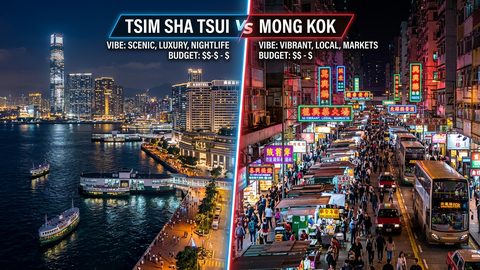 Tsim Sha Tsui vs Mong Kok — Choosing Your Kowloon Base by Budget and Vibe
TST or Mong Kok for your Kowloon base? Compare nightly rates, MTR exits, noise levels, and street vibe to pick the right fit for your Hong Kong trip.
Tsim Sha Tsui vs Mong Kok — Choosing Your Kowloon Base by Budget and Vibe
TST or Mong Kok for your Kowloon base? Compare nightly rates, MTR exits, noise levels, and street vibe to pick the right fit for your Hong Kong trip.